Convolutional Sparse Coding (ADMM)
This example demonstrates the solution of a simple convolutional sparse coding problem
where the \(\mathbf{h}\)_k is a set of filters comprising the dictionary, the \(\mathbf{x}\)_k is a corrresponding set of coefficient maps, and \(\mathbf{y}\) is the signal to be represented. The problem is solved via an ADMM algorithm using the frequency-domain approach proposed in [59].
[1]:
import numpy as np

import komplot as kplt

import scico.numpy as snp
from scico.examples import create_conv_sparse_phantom
from scico.functional import L1MinusL2Norm
from scico.linop import CircularConvolve, Identity, Sum
from scico.loss import SquaredL2Loss
from scico.optimize.admm import ADMM, FBlockCircularConvolveSolver
from scico.util import device_info
kplt.config_notebook_plotting()
Set problem size and create random convolutional dictionary (a set of filters) and a corresponding sparse random set of coefficient maps.
[2]:
N = 128  # image size
Nnz = 128  # number of non-zeros in coefficient maps
h, x0 = create_conv_sparse_phantom(N, Nnz)
Normalize dictionary filters and scale coefficient maps accordingly.
[3]:
hnorm = np.sqrt(np.sum(h**2, axis=(1, 2), keepdims=True))
h /= hnorm
x0 *= hnorm
Convert numpy arrays to jax arrays.
[4]:
h = snp.array(h)
x0 = snp.array(x0)
Set up sum-of-convolutions forward operator.
[5]:
C = CircularConvolve(h, input_shape=x0.shape, ndims=2)
S = Sum(input_shape=C.output_shape, axis=0)
A = S @ C
Construct test image from dictionary \(\mathbf{h}\) and coefficient maps \(\mathbf{x}_0\).
[6]:
y = A(x0)
Set functional and solver parameters.
[7]:
λ = 1e0  # ℓ1-ℓ2 norm regularization parameter
ρ = 2e0  # ADMM penalty parameter
maxiter = 200  # number of ADMM iterations
Define loss function and regularization. Note the use of the \(\ell_1 - \ell_2\) norm, which has been found to provide slightly better performance than the \(\ell_1\) norm in this type of problem [60].
[8]:
f = SquaredL2Loss(y=y, A=A)
g0 = λ * L1MinusL2Norm()
C0 = Identity(input_shape=x0.shape)
Initialize ADMM solver.
[9]:
solver = ADMM(
    f=f,
    g_list=[g0],
    C_list=[C0],
    rho_list=[ρ],
    alpha=1.8,
    maxiter=maxiter,
    subproblem_solver=FBlockCircularConvolveSolver(check_solve=True),
    itstat_options={"display": True, "period": 10},
)
Run the solver.
[10]:
print(f"Solving on {device_info()}\n")
x1 = solver.solve()
hist = solver.itstat_object.history(transpose=True)
Solving on GPU (NVIDIA GeForce RTX 2080 Ti)

Iter  Time      Objective  Prml Rsdl  Dual Rsdl  Slv Res
----------------------------------------------------------
   0  2.45e+00  2.107e+03  3.851e+01  5.291e+01  6.771e-06
  10  3.74e+00  2.862e+03  4.623e+00  9.837e+00  7.471e-06
  20  3.85e+00  2.702e+03  2.097e+00  6.156e+00  8.159e-06
  30  3.97e+00  2.626e+03  1.528e+00  4.603e+00  1.060e-05
  40  4.08e+00  2.578e+03  1.222e+00  3.719e+00  1.312e-05
  50  4.20e+00  2.542e+03  1.124e+00  3.478e+00  1.011e-05
  60  4.33e+00  2.511e+03  1.053e+00  3.260e+00  9.227e-06
  70  4.46e+00  2.486e+03  9.754e-01  3.012e+00  1.460e-05
  80  4.59e+00  2.464e+03  8.965e-01  2.773e+00  9.706e-06
  90  4.73e+00  2.444e+03  8.411e-01  2.613e+00  1.212e-05
 100  4.87e+00  2.426e+03  8.010e-01  2.495e+00  1.139e-05
 110  4.99e+00  2.411e+03  7.589e-01  2.367e+00  6.826e-06
 120  5.10e+00  2.398e+03  7.139e-01  2.224e+00  7.160e-06
 130  5.21e+00  2.386e+03  6.679e-01  2.076e+00  4.309e-06
 140  5.33e+00  2.377e+03  6.111e-01  1.881e+00  1.699e-05
 150  5.43e+00  2.368e+03  5.547e-01  1.717e+00  1.301e-05
 160  5.54e+00  2.361e+03  5.137e-01  1.595e+00  1.007e-05
 170  5.64e+00  2.356e+03  4.663e-01  1.439e+00  1.254e-05
 180  5.74e+00  2.352e+03  4.245e-01  1.301e+00  6.956e-06
 190  5.86e+00  2.348e+03  3.735e-01  1.135e+00  1.350e-05
 199  5.96e+00  2.347e+03  3.066e-01  8.973e-01  7.575e-06
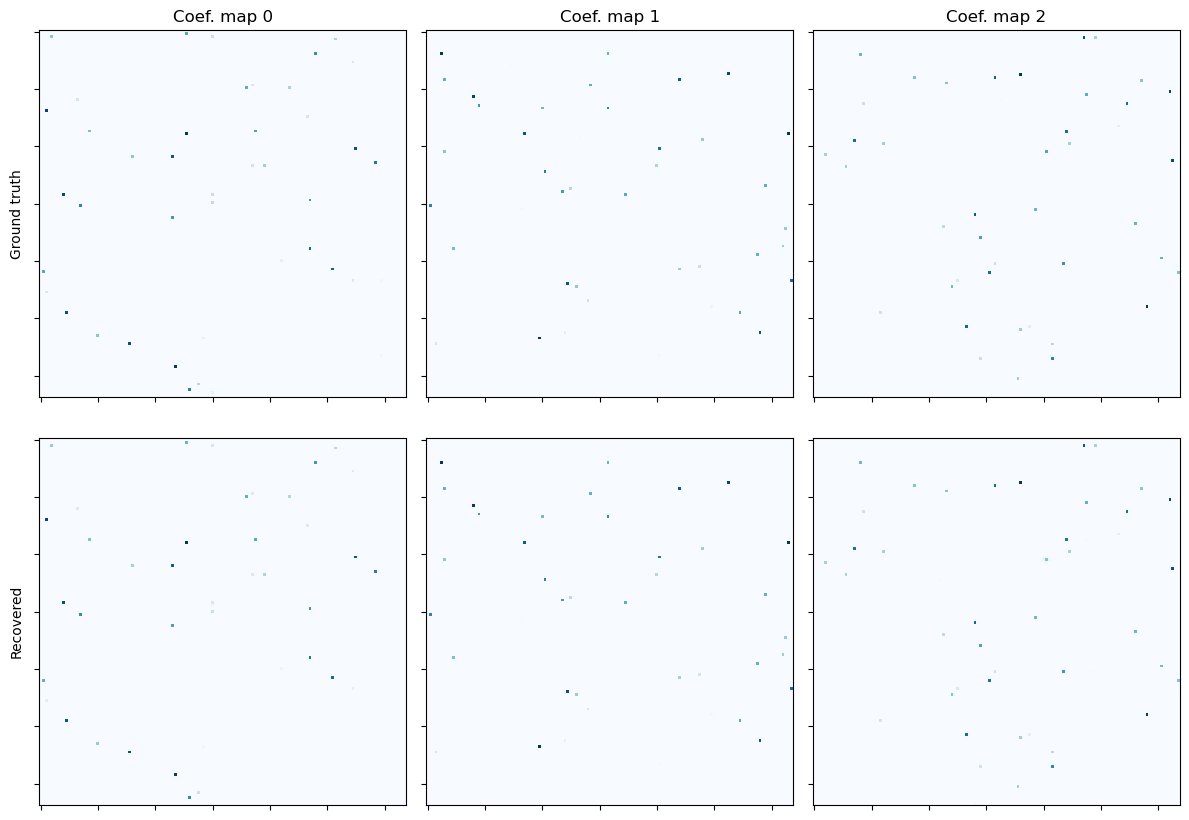
Show the recovered coefficient maps.
[11]:
fig, ax = kplt.subplots(nrows=2, ncols=3, sharex=True, sharey=True, figsize=(12, 8.6))
kplt.imview(x0[0], title="Coef. map 0", cmap=kplt.cm.Blues, ax=ax[0, 0])
ax[0, 0].set_ylabel("Ground truth")
kplt.imview(x0[1], title="Coef. map 1", cmap=kplt.cm.Blues, ax=ax[0, 1])
kplt.imview(x0[2], title="Coef. map 2", cmap=kplt.cm.Blues, ax=ax[0, 2])
kplt.imview(x1[0], cmap=kplt.cm.Blues, ax=ax[1, 0])
ax[1, 0].set_ylabel("Recovered")
kplt.imview(x1[1], cmap=kplt.cm.Blues, ax=ax[1, 1])
kplt.imview(x1[2], cmap=kplt.cm.Blues, ax=ax[1, 2])
fig.tight_layout()
fig.show()
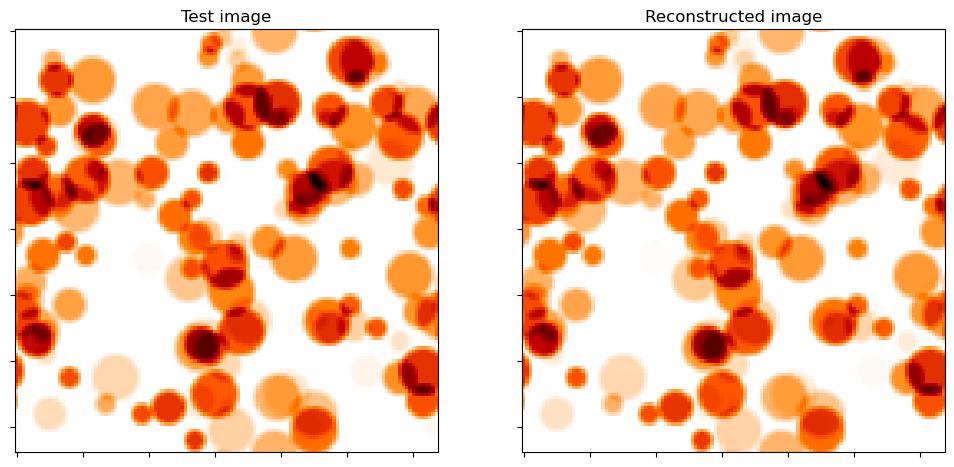
Show test image and reconstruction from recovered coefficient maps.
[12]:
fig, ax = kplt.subplots(nrows=1, ncols=2, sharex=True, sharey=True, figsize=(12, 6))
kplt.imview(y, title="Test image", cmap=kplt.cm.gist_heat_r, ax=ax[0])
kplt.imview(A(x1), title="Reconstructed image", cmap=kplt.cm.gist_heat_r, ax=ax[1])
fig.show()
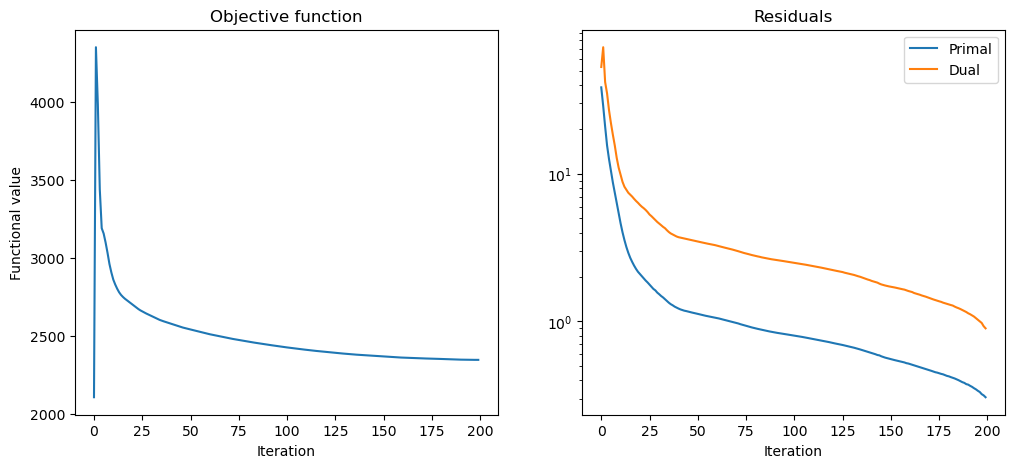
Plot convergence statistics.
[13]:
fig, ax = kplt.subplots(nrows=1, ncols=2, figsize=(12, 5))
kplt.plot(
    hist.Objective,
    title="Objective function",
    xlabel="Iteration",
    ylabel="Functional value",
    ax=ax[0],
)
kplt.plot(
    snp.array((hist.Prml_Rsdl, hist.Dual_Rsdl)).T,
    ylog=True,
    title="Residuals",
    xlabel="Iteration",
    legend=("Primal", "Dual"),
    ax=ax[1],
)
fig.show()